The spice merchants of the Marrakech Medina open before the heat does. By six, the stalls along Rahba Kedima are already mounded — cumin the color of dust, paprika the color of brick, turmeric so saturated it looks lit from within. Nobody is buying yet. The merchants are simply arranging, the way a painter mixes color before deciding what to paint.
To call this a spice market, in the way a Western visitor might use the term, undersells what's actually happening. These are not seasonings sold in isolation. Most stalls sell blends — ras el hanout chief among them, a mixture that can run anywhere from a dozen spices to over thirty, varying not just stall to stall but merchant to merchant, each guarding a formula passed down rather than written down.
We spent eight days in the Medina, following spice from the souk to the tagine, trying to understand a culinary tradition built less on individual ingredients than on the relationships between them — and on the women, often invisible to outside visitors, who do most of the actual cooking.

Thirty Spices, One Secret
Hassan Belkadi has run his stall for twenty-eight years, inheriting it from an uncle who had no children of his own. His ras el hanout — the name translates roughly to "head of the shop," meaning the merchant's finest blend — contains, by his count, thirty-one ingredients, though he has never written the full list down and was reluctant to recite it to us in full. "If I tell you everything, you do not need me anymore," he says, only half joking, scooping a fragrant amber powder into a paper cone.
What he will say is that the blend includes the expected base — cumin, coriander, cinnamon, ginger — alongside things a casual cook would never think to add: dried rosebuds, grains of paradise, sometimes a trace of cantharides, though he's quick to clarify that's largely ceremonial in modern blends, a nod to the mixture's old reputation as much else besides a seasoning. "My grandmother's version had things in it that nobody sells anymore," he says. "Mine is what's left. Still good. Different good."
"A blend is not a recipe. A recipe, anyone can copy. A blend is a memory of every batch that came before it, adjusted a little each time. You cannot copy a memory."
— Hassan Belkadi, spice merchant, Rahba KedimaQuality, Hassan tells us, is judged first by smell, never by appearance alone — a vivid color can be achieved with dye, but aroma cannot be faked. He has us close our eyes and inhale from three different cones, each one noticeably different, though to an untrained nose the distinctions were subtle: one warmer, one sharper, one with a faint sweetness underneath. "Tourists buy with their eyes," he says. "Cooks buy with their nose. I can tell which one you are by how long you keep your eyes closed."
The Kitchens Behind the Kitchens
Much of what defines Marrakchi home cooking happens not in restaurants but in private kitchens, often run by women whose names rarely appear on a menu. We were welcomed into the home of Khadija Amrani, a cook in her sixties who has spent decades preparing meals for large family gatherings and, more recently, for a small number of visitors arranged through a friend of a friend.
A Tagine Has No Recipe
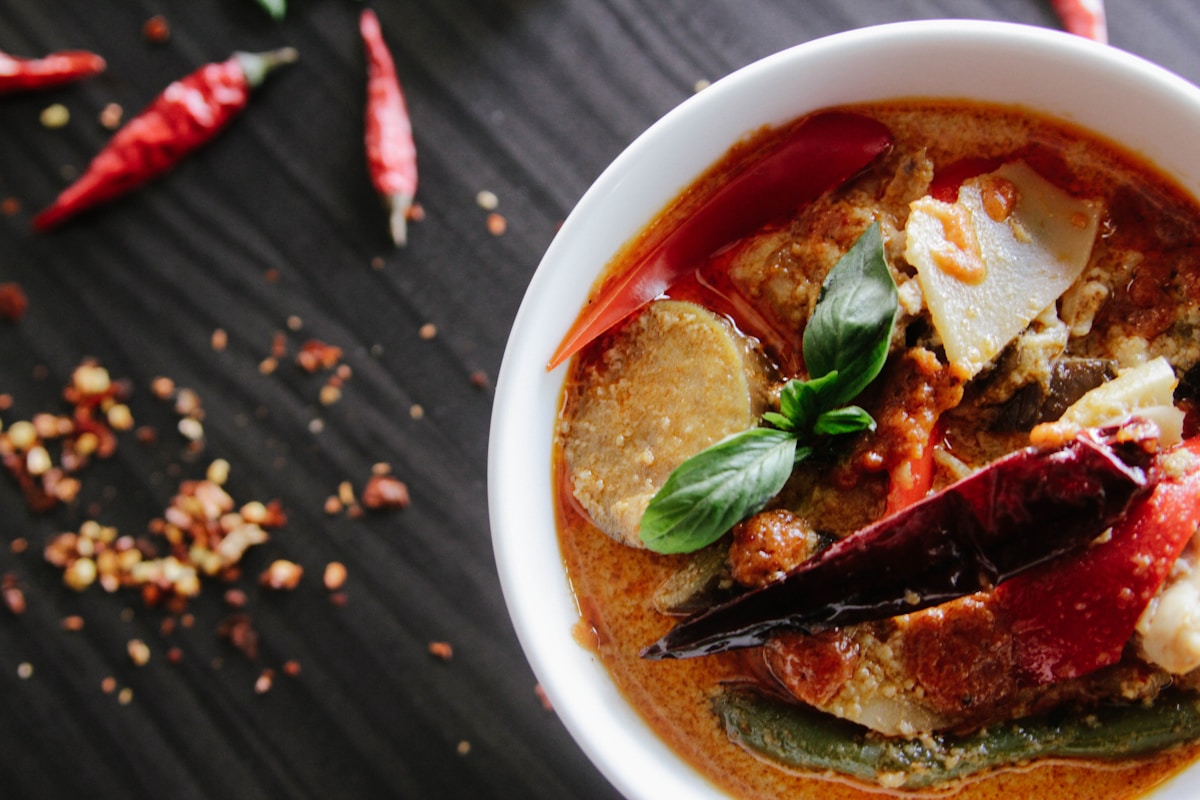
Khadija's kitchen has no measuring cups. Spice is added by handful and adjusted by taste, sometimes mid-cook, sometimes the next day when the dish is reheated and somehow improved by the wait. "A tagine is not finished when you turn off the heat," she tells us, layering preserved lemon and olives over a lamb and prune tagine that had simmered, lid sealed, for nearly three hours. "It is finished tomorrow, when you eat the rest."
She learned to cook from her mother, who learned from hers, and she is visibly uneasy with the idea of teaching from a written recipe, a format she considers almost dishonest. "A recipe says 'one teaspoon.' But whose teaspoon? My mother's hand was bigger than mine. The dish needs what it needs, not what the paper says." When we ask her to estimate quantities for us anyway, she laughs and shakes her head. "Watch. Smell. Taste. Those are the measurements."
"Men buy the spice in the souk. Women decide what it becomes. Nobody writes this part down because everybody already knows it — except, it seems, the people writing the cookbooks."
— Khadija Amrani, home cook, MarrakechWhere Souk Meets Restaurant
Outside the home kitchens, a newer generation of Marrakech chefs has begun translating souk traditions into restaurant menus — not by simplifying them, but by making the invisible visible. Chef Yassine Cherkaoui, who trained in Paris before returning to open a small restaurant near the Medina's edge, sources his ras el hanout from four different merchants, including Hassan, blending them himself to chase a flavor he remembers from childhood rather than any single seller's version.
"I am not trying to improve on the souk," he tells us, plating a saffron-laced chicken with preserved lemon. "I am trying to be honest about how much work happens before the food even reaches a kitchen. People taste a tagine and think the cooking is the hard part. The cooking is maybe twenty percent. The rest happened in the souk, over decades, before I was even born."
This layering — souk to home kitchen to restaurant, each step adding interpretation without erasing what came before — is, more than any single dish, what defines Marrakchi cuisine to an outsider's eye. Nothing is invented from nothing. Everything is inherited, adjusted, passed forward.
What the Souk Remembers
On our last morning in the Medina, we returned to Hassan's stall before the heat set in. He was, as always, arranging his cones — cumin, paprika, turmeric, the deep ochre mound of his unlabeled ras el hanout — with the same unhurried attention he'd shown on our first visit. We asked him whether he thought the blend would survive him, whether anyone in his family wanted to inherit the stall the way he once had.
He considered the question for a long moment, the way Khadija had considered ours about quantities. "My daughter says no, never," he said finally. "But my daughter said the same thing about cooking, and now she makes the best couscous in our family. The souk has a way of changing people's minds. I am not worried." He handed us a small paper cone, unweighed, unpriced — a gift, not a sale. "Smell this in a year. Tell me if you remember Marrakech."